
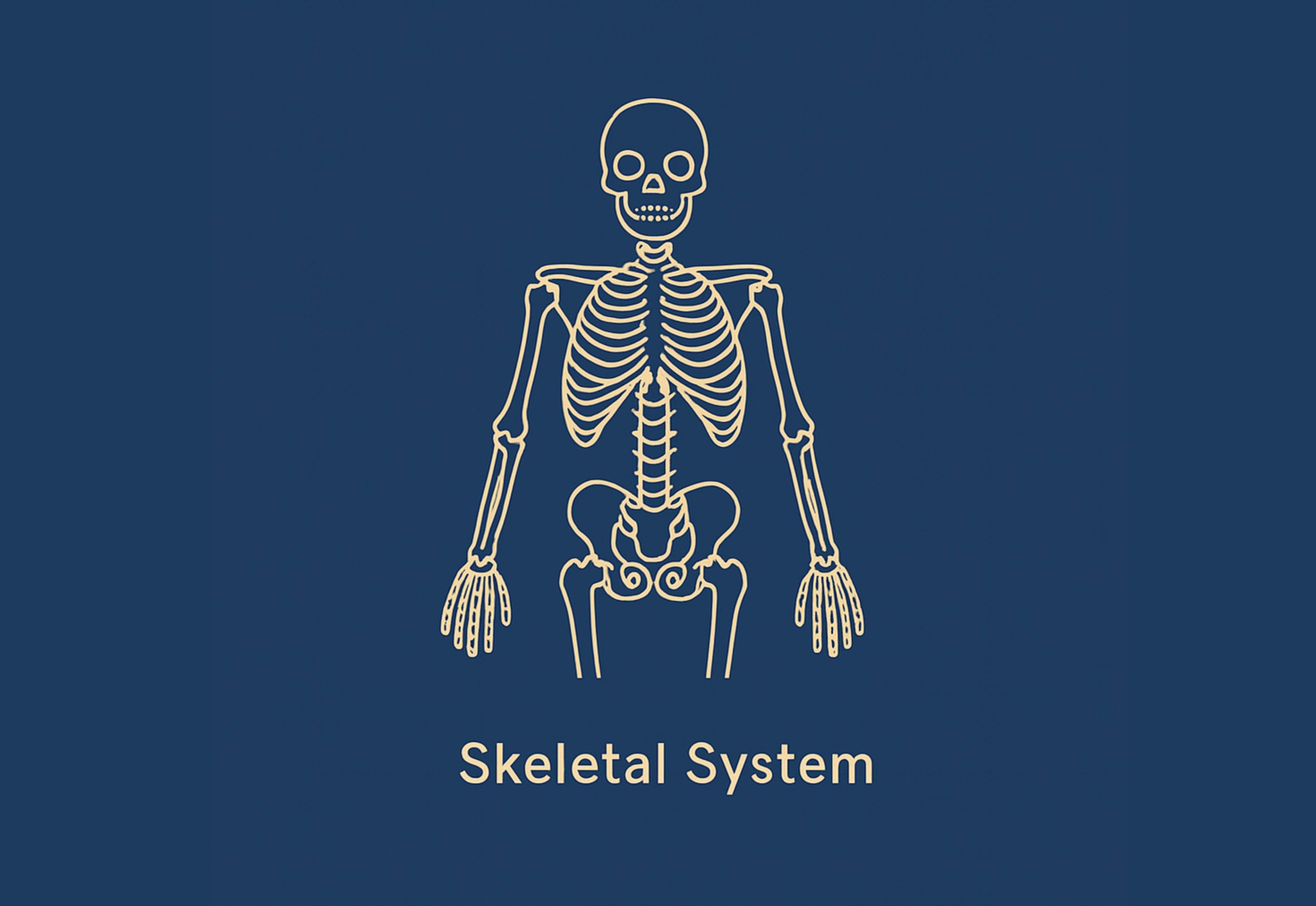
Welcome to Part One of The OsmoHealth Journal’s Human Body System Series, a deep dive into the skeletal system, they very foundation that holds us together.
When most people think of bones, they imagine lifeless structures, something solid, white, and still. But in reality, your skeleton is alive. It grows, heals, and works hand in hand with every other system in your body. Without it, we wouldn’t be able to stand, move, protect vital organs, or even produce blood cells.
In this article, we’ll break down the anatomy and function of the skeletal system; exploring the types of bones, their structure, how they grow, and what keeps them healthy.
1. What is the Skeletal System?
The skeletal system is a living framework made up of bones, cartilage, ligaments, and joints. Altogether, it forms a support structure that gives our body shape, allows movement, and protects delicate organs.
In an average adult, the skeleton contains 206 bones, but at birth, that number is closer to 270, many of which later fuse together as we grow.
The skeletal system has five main functions:
- Support: It gives your body shape and structure.
- Protection: It shields organs like the brain (inside the skull) and the heart and lungs (behind the rib cage).
- Movement: Muscles attach to bones; when they contract, bones move like levers.
- Storage: Bones act as reservoirs for essential minerals like calcium and phosphorus.
- Blood Cell Production: Red & White blood cells are made inside the bone marrow, particularly in flat bones like the pelvis and sternum.
So, while bones may seem rigid and still, they are constantly working behind the scenes to keep you alive and balanced.
2. The Different Types of Bones
Not all bones are the same, each is shaped for a specific job. Scientists classify bones into five main categories based on shape and function:
– Long Bones
These bones are longer than they are wide and work like levers to produce movement. They include the femur (thigh), humerus (upper arm), and metacarpals (hands).
– Short Bones
These bones are roughly cube-shaped and designed for strength and stability rather than movement. Examples include the carpals in the wrist and tarsals in the ankles.
– Flat Bones
Flat bones are thin, curved, and serve as protective shields; like the skull, ribs, and scapulae (shoulder blades). They also provide broad surfaces for muscle attachment.
– Irregular Bones
These have complex shapes that don’t fit into any other category, such as the vertebrae (spinal bones) and many facial bones.
– Sesamoid Bones
Small and round, these bones form the inside tendons to protect them from stress. The patella (kneecap) is the largest sesamoid bone and plays a major role in knee movement.
Together, these different bone types build a system that is strong, lightweight, and perfectly adapted to every part of your body.
3. Inside a Bone: Structure and Composition
Although bones seem solid, they are actually made of several layers working altogether:
- Compact Bone: The hard outer layer that gives strength and shape.
- Spongy Bone: Found inside bones, it has a honeycomb-like structure that makes bones lighter while still strong.
- Bone Marrow: The soft tissue inside bones that produces blood cells.
- Periosteum: A thin outer membrane that nourished the bone and connects it to muscles and ligaments.
Bones are built by specialised cells:
- Osteoblasts build new bone tissue.
- Osteocytes maintain bone health.
- Osteoclasts break down old bone, allowing new bone to form.
This continuous cycle, known as bone remodelling, ensures that bones stay strong and can repair themselves after injury. It’s one of the reasons a broken bone can heal over time.
4. The Axial and Appendicular Skeleton
The skeletal system is divided into two major parts:
The Axial Skeleton
This is the central core of the body. It includes:
- Skull
- Vertebral column (spine)
- Ribs and sternum
- Hyoid bone and ear ossicles
These bones mainly protect vital organs and support your head and torso.
The Appendicular Skeleton
This includes the limbs and the bones that attach them to the body:
- Shoulder girdles (clavicle and scapula)
- Arms and hands
- Pelvic girdle (hips)
- Legs and feet
The appendicular skeleton is designed for movement. It’s what lets us run, lift, grab, and interact with our environment.
Together, the axial and appendicular skeletons create a balanced system, one half built for protection and posture, the other for mobility and action.
5. Joints: Where Movement Happens
Where two bones meet, you’ll find a joint (or articulation). Joints are what make the skeleton flexible.
Types of Joints by Movement:
- Immovable (synarthroses) – e.g., the skull sutures.
- Slight movable (amphiarthroses) – e.g., between vertebrae.
- Freely movable (diarthroses) – e.g., knees, elbows, and shoulders.
Types of Synovial Joints (Freely Movable):
- Ellipsoid joints – Allow bending and side motion (wrist base).
- Plane joints – Slide over one another (wrists, ankles).
- Hinge joints – Move in one direction (elbows, knees).
- Saddle joints – Enable movement in two planes (thumb).
- Ball-and-socket joints – Allow rotation in all directions (shoulder, hip).
- Pivot joints – Permit rotation (neck, forearm).

6. How Bones Grow and Develop
Bones form and grow through processes called ossification or osteogenesis. In the embryo, two main processes lay down new bone:
- Intramembranous ossification: Bone develops directly from sheets of embryonic connective tissue (mesenchyme). Flat bones, like most skull bones, the mandible, and parts of the clavicle, are formed this way.
- Endochondral ossification: Bone develops by replacing a cartilage template. Most long bones and other bones (like the femur, humerus, and vertebrae) form by first growing as cartilage models that are gradually turned into bone.
In both processes, the result is true bone tissue, but intramembranous skips the cartilage stage. The difference is simply how the bone is laid down during development.
After birth, bones continue to grow in length at the epiphyseal plates (growth plates) near each end of long bones. These plates are layers of cartilage that multiply and are gradually replaced by bone tissue, helping the bone to grow longer. As adolescence ends and adulthood begins (around age 18–21), the cartilage growth plates close and become solid bone (epiphyseal lines). This explains why children’s bones can grow taller, but adult bones do not lengthen further.
Bones also grow in thickness by adding new bone under the periosteum. Throughout life, bone remodelling continues: older bone is resorbed by osteoclasts and new bone is added by osteoblasts. This turnover allows bone to adapt to stresses and repair tiny micro-damages. Overall, the processes of ossification, growth at plates, and remodelling regulate how bones develop and maintain their strength over time.
7. Common Skeletal System Disorders
Even though bones are strong, they can still be affected by disease or injury. Here are some of the most common skeletal issues:
Osteoporosis
A condition where bones become weak and fragile due to loss of density. It’s often called the “silent disease” because it develops slowly and usually isn’t noticed until a fracture occurs. Proper nutrition, calcium intake, and exercise can help prevent it.
Fractures
A fracture is a broken bone, caused by trauma, stress, or weakened bone. The body repairs it naturally through several stages: blood clot, soft callus, hard callus, and remodelling. Doctors may use casts or surgical plates to help it heal properly.
Arthritis
An inflammation of the joints that leads to pain, stiffness, and swelling.
- Osteoarthritis wears down cartilage from long-term use.
- Rheumatoid arthritis is an autoimmune condition that attacks the joint linings.
Scoliosis
A sideways curvature of the spine that usually appears during growth spurts in adolescence. Mild cases may not cause symptoms, but sever scoliosis can lead to uneven posture and back pain.
Being aware of these conditions helps us understand the importance of maintaining bone health from an early age.
8. Keeping Your Bones Healthy
Strong bones don’t just happen, they need care. Here are a few science backed ways to keep your skeletal system healthy:
- Eat calcium-rich foods: Dairy products and leafy greens.
- Get enough Vitamin D: It helps your body absorb calcium.
- Exercise regularly: Weight-bearing activities (like walking, jogging, or resistance training) keep bones dense and strong.
- Avoid smoking and excessive caffeine: Both can weaken bones over time.
- Maintain proper posture: It reduces stress on the spines and joints.
Taking care of your bones now can prevent serious problems later, especially conditions like osteoporosis or chronic back pain.
Conclusion: More Than Just a Skeleton
The skeletal system is far more than a collection of bones, it’s a living network that supports, protects, and empowers every movement we make. From the compact strength of long bones to the delicate balance of joints, every part of the skeleton plays a vital role.
This Part 1 of The OsmoHealth Journal’s Human Body System Series sets the stage for understanding how all systems, muscular, nervous, circulatory, and beyond, work together to create life itself.
Next in the series: The Muscular System, how your muscles connect with bones to bring the body to motion.
References
- Britannica. (n.d.). Skeleton summary. Encyclopedia Britannica. https://www.britannica.com/summary/skeleton
- Cleveland Clinic. (n.d.). Osteoporosis: Symptoms, causes & treatment. Cleveland Clinic. https://my.clevelandclinic.org/health/diseases/4443-osteoporosis
- Healthline. (n.d.). The skeletal system: Anatomy and function. Healthline. https://www.healthline.com/health/skeletal-system
- OpenStax. (n.d.). Bone formation and development. Anatomy and Physiology 2e. OpenStax. https://openstax.org/books/anatomy-and-physiology-2e/pages/6-4-bone-formation-and-development
- Visible Body. (n.d.). Types of bones. Visible Body. https://www.visiblebody.com/learn/skeleton/types-of-bones
Leave a Reply